

Hey TV Murderers, You're Staging Suicides Wrong
Or, what fiction detectives get wrong about suicide

Picture this, a man is working late at night in his lab. You watch him pause. He hears a noise, investigates, but there’s nothing, no one there. He hears the noise again and checks. He is not the clever one in a horror movie. Your incredulity grows. He is acting like the first victim in a horror movie. The one who asks “Who’s there?” as if murderous ghosts would introduce themselves like Jehovah’s Witness recruiters. Suddenly, butterflies swarm out of a vent. They surround him. He’s screaming in agony. A whirlwind of lethal insects overwhelms him. He flails his arms as though they are hurting him. But they’re butterflies, what could they possibly be doing to him? Before you have another thought, he jumps out the window and plummets to his death.
Intrepid “weird things” special agent Olivia Dunham (Anna Torv) of the FBI’s Fringe Division then investigates the man’s death, refusing to believe the post-mortem report that the man died by suicide. Her main argument was that he had a trip planned and seemed organised, upbeat. It can’t have been suicide. How could it? The belief that victims of suicide have to conform to ascertained stereotypes made me wonder, is that why people have a hard time believing who would complete a suicide?
It's no secret that pop culture directly influences how others are treated in society. You may think yourself “above it all”, immune to the vapid portrayals of specific individuals meant to represent a whole. Studies show that this is completely untrue. Micro-economics professor Haimanti Bhattacharya’s research found that exposure to mass media in India that spread awareness against intimate partner violence reduced instances of “justifying wife beating”. In a study on the impact of Brazilian TV on family planning Eliana La Ferrara, Alberto Chong, and Suzanne Duryea stated, “constant exposure to smaller, less-burdened television families, may have created a preference for fewer children and greater sensitivity to the opportunity costs of raising children.” There are many other instances where portrayals of certain societal behaviours on TV, movies, music videos directly influenced daily interactions with people of the corresponding demographics. When it comes to the never-suicide trope, it’s not farfetched to think the same thing happens.
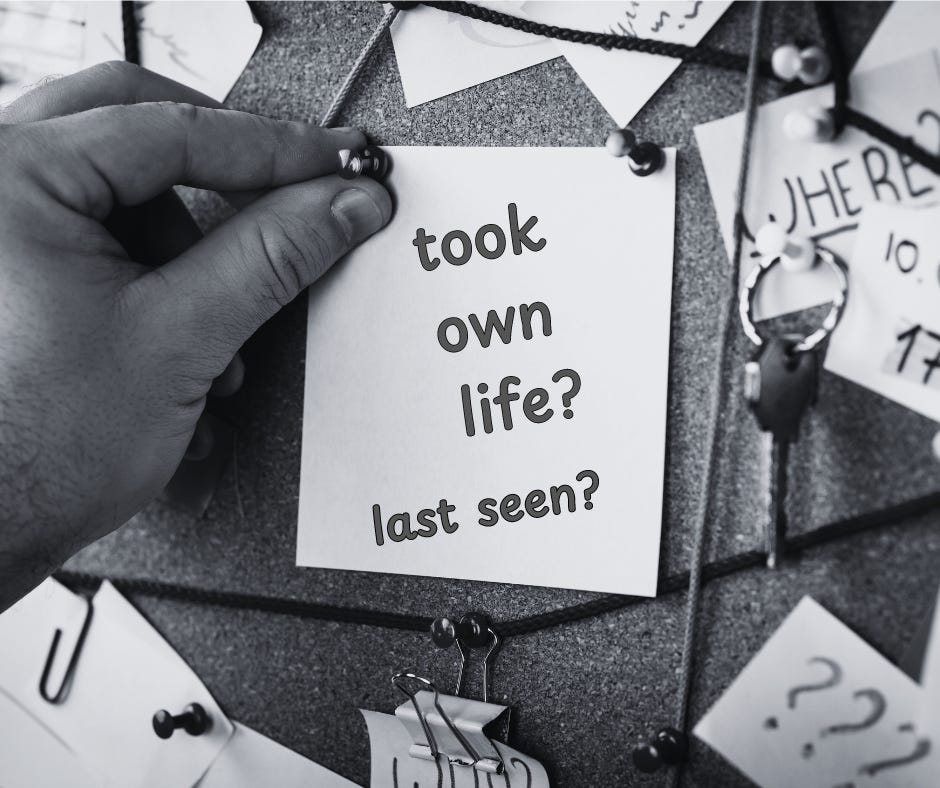
TV suicidal thought vs “real” suicidal thought
In pop media, suicide is depicted as a dramatic, heart-rending tragedy that befalls a family. The victim’s loved ones are the ones whose pain is the focus. “How could he do this to us?” is a common refrain sung by survivors of those who completed suicide. But in the never-suicide trope, “There’s no way he could have killed himself.” This is because there is the belief that suicide victims have to act a certain way.
The first time I thought about suicide I was 12 years old. I had just come from a doctor’s appointment after a headache that wouldn’t quit for almost a week. My father took me to get tested for malaria but the doctor said they found nothing wrong in my bloodwork. He suggested stress but what could a young girl possibly be stressed about? School? You should be stressed about that anyway. Unfortunately, my father was at the time married to a woman who was cruel and abusive. As such, I had to consider if slitting my wrists open would spare me the pain of having to live with her. Ultimately, I decided not to go through with it because death was a fearful unknown.
The next time I felt suicidal was in high school. Nothing was particularly wrong with me. I just felt down and dour all the time. Eyeore was my idol. Everything hurt, everything was dark, I just wanted to let go. Listening to Linkin Park’s music made me feel seen but I couldn’t explain what it was that I was exhibiting. Why did living hurt so much? Eventually, my solution became hypersomnia. Outside of some classes like math, chemistry and physics, I would just sleep the days away until the miasma passed.
By the time I got to college, internet penetration in my country had grown. I could also now access Google from my cell phone. After researching my symptoms, I found I displayed signs of depression and anxiety. I wouldn’t go see a therapist until I was 29 to get a full diagnosis but it was nice to put a name to the beast that plagued me every waking moment. I also figured it was par for the course since every writer I’ve ever admired has battled mental illness in one way or another. As I dug more and more into how it manifests, I came across a phrase that perfectly encapsulated how I’d felt since I was a little girl blithely contemplating the slicing effectiveness of a kitchen knife on prepubescent wrists.
Suicidal ideation
When you actively plan out a suicide, this is known as suicidal ideation. But the scientific community doesn’t have a consensus on what it entails. Is ideation just planning? Picturing it and thinking about doing it? I don’t know. I do know that when I hit rock bottom, and I bounce it around a lot, I start thinking about it with startling ease. This is considered taboo in my culture. Among Kenyans, death is something that should be avoided at all costs—even talking about it. Taking your life is one of the most unforgivable sins you could commit. Not only is it expressly forbidden but it’s also “insulting” and “selfish”.
And yet, suicidal ideation is a lot more common than most denialists would think. A post-COVID-19 study found younger people are at higher risk of suicidal ideation because of anxiety, loss of employment or isolation. A public health journal, however, found that suicide attempts are more common among women while suicide deaths are more common among men. Many articles will give advice on what to look out for among people who are suicidal. They will abuse drugs more, they will look or act depressed, they will say goodbye, they will sleep more or less, they will shut down, they will post lyrics of Linkin Park’s Leave Out all the Rest on their Insta stories often. This is why TV detectives feel like Sherlock Holmes incarnations when they look at a deceased’s personal effects. They will have organised laundry, plans to go on a trip in a month, a healthy social life. So they couldn’t possibly be suicidal. I beg to differ.
I like to call myself a high-functioning depressive1. The state of my life doesn’t allow me to remain in bed for days on end because I just, can’t. There are days I am unable to lift a hand to even feed myself. But I have a cat and he is a demanding tyrant who must have a clean environment and ready food at his meal times. In a way, I have tethered my living to him, literally making him my reason for being. And so, when my friends call, I go out even though I’d rather lay at the bottom of a pit and wait for the bitter end when I can shuffle off this burning mortal coil.
At work, I show up. When I can barely deliver because of the weight of these burdensome thoughts I simply go to work. Unlike countries like the UK which offers mental health leave which is equivalent to sick leave, or the Netherlands which offers up to 70% pay sick leave even for mental health crises, it’s difficult to ask for time off in Kenya for mental health recovery. Not only is there stigma against mental health, asking for time off for “issues” is a sure-fire way to plant a target on your back for retrenchment. A common theme would be that everyone is facing the same uncertainty, the same problems, the same policies costing them everything. And while mental health issues aren’t a depression Olympics, those with pre-existing mental illness have to tread carefully. When I previously lost a job, I told my father about how the economic downturn had made it hard to find a job anywhere. He commiserated talking about how their industry was constantly downsizing. He also shared how bad things are for “the youth” and how depression cases are rising among them. But in his mind, these are young men who live below the poverty line with dependents, low-income jobs and probably substance abuse problems. When I told him I’d gone to see a psychiatrist at an outpatient government mental hospital he suggested I try going outdoors instead to get rid of “negativity”. When TV reinforces that only people of a certain disposition can be suicidal they do us a great disservice. And I, for one, would at least like my parents to believe that suicidal ideation can happen to their “functional” little girls.
How TV murderers can successfully stage a suicide
TV shows reinforce the image of suicide victims even when they try to use suicide as a red herring. People with suicidal ideation can’t have normal, boring days. They have to be miserable, checked out, doing drugs, sunk to rock bottom. But suicide and suicidal ideation is a spectrum. A victim who is at the peak of their career, married to the love of their life and happy as a daisy one day can be just as suicidal as someone whose house turned into a hoarding nightmare, infested with pests and covered in matted hair. Talinda Bennington once shared a video of her husband Linkin Park frontman, Chester Bennington, three days before he completed his suicide. He looked happy.
If TV murderers want to better stage suicides, they may need to imbue these perceived stereotypes in their victims so that they can better get away with murder. On TV alone, suicide victims can’t be put together. They can’t have something to look forward to. They can’t be connected with the world, altruistic, teetotal, libidinous, joyful. In the never-suicide trope, the TV murderer is caught because they don’t look at their victim’s personal life.
But should they want to be successful, they need to make their victims fit this stereotypical profile. If they are stalking their targets, they have to see whom they have the most contact with. The TV murderer should even clone their target’s phone and send cryptic messages contemplating life, or post Linkin Park lyrics on their Insta stories, “When my time comes, forget the wrongs that I’ve done, help me to rewind some reasons to be missed…” There’s also blink 182’s Adam’s Song, R.E.M’s Everybody Hurts, Third Eye Blind’s Jumper. If they don’t listen to rock music, a sad pop ballad like The Fray’s How to Save a Life. Once they’ve planted that seed, they can make their target stop replying to messages and texts by changing their passcodes and ensuring they aren’t receiving any correspondence. After this, they can ensure that everything goes wrong for their target. Are they taking a hot shower? Cut the power, let the water turn icy as they raise their face to rinse off the soap. Keep them awake by putting a noise machine in their house that plays annoying sounds like a dripping tap.
After performing these covert operations for a few days, their target will crack showing up to work with raccoon eyes, unkempt hair and paranoia. When they finally kill their target, the TV detective will go through their personal effects and find that they were slowly losing their minds over a few weeks. And even though there isn’t a history of mental illness in their family, the TV detective will chalk it up to “the world these days.” Unfortunately, if the TV detective works for an organisation with a budget, they’ll find out that the phone was called with the power of cyber jibber jabber and realise that the poor victim was manipulated and killed to make it look like a suicide.
Do we even need suicide representation?
In a meta-analysis of multiple studies on the impact of the depiction of suicide and suicidal ideation, 53% of the studies showed it led to an increase in suicidal behaviour and suicidal thought. 24% of the studies found no change in suicidal behaviour while 18% found decreases in the same. It’s believed that witnessing suicidal behaviour can lead to increased thought in people who already had suicidal ideation. Studies found that the TV show 13 Reasons Why, an adaptation of a book by the same name, increased suicidal ideation by 50%. However, this is also more common among people with thought suppression.
The same study also found that exposure to suicide in media leads to increased awareness, stigma reduction, and making it easier to seek help. According to Factual America, the 2006 documentary The Bridge, which focuses on suicides completed on the San Fransisco Golden Gate Bridge, people gained more empathy and understanding towards the nuances of suicide. However, some viewers still found the material objectionable, graphic and potentially capitalising on the loss of others. But it also led to more prevention measures being passed such as safety features on the bridge to prevent more suicides and providing resources to those with suicidal thoughts. The documentary had an intent and one can argue that that was met. But when a TV murder show brings up suicide, even as a plot twist, should it have the same responsibility?
What media can do right
While it may be difficult to stage a TV suicide to suit an ingredients list of symptoms and stereotypes, perhaps TV will show my parents that suicidal thought doesn’t have typical behaviour. Sensationalised media like 13 Reasons Why, in my opinion, does little for suicide awareness and the other end of the gamut is a never-suicide misdirect.
Helpful portrayals of suicide and suicidal ideation like Ted Vizzini’s It’s Kind of a Funny Story or Stephen Chbosky’s The Perks of Being a Wallflower give a more rounded view of a complex issue. Most people are less likely to read these two amazing books. They’re more likely to watch an episode of CSI or Fringe. And while those shows have no responsibility for representation, they still need to balance the sensational with the material. It's ok to have a suicide victim be “normal”. It’s ok that people with suicidal ideation can mock or make little of their illnesses, or even ignore them. It’s ok that no one called when we decide to complete it, though not everyone with suicidal ideation follows through. Suicidal ideation isn’t some silent killer. In many instances, the signs of suicide won’t be there and TV detectives must show that.
The term “high-functioning” is considered offensive by many people with mental health conditions because it implies the existence of depressed people who are less important. I am using it in a different context.
It really is a shame that depression, one of the most devastating human illnesses, is also one of the most misunderstood. Sometimes I just wish it was something physical, like cancer, something they can detect with a scan. Then the tremendous ostracism that surrounds the illness would perhaps be greatly reduced. For how absurd it is for a depressive to have someone say to them, It will pass, we all have our bad days, or something of that sort. As absurd as saying the same thing to a cancer patient. For the mind is as part of the body as the liver or the lung. Anyway, this is a wonderful study of suicide, and it's misrepresentation.
Also, apart from those two books (I loved that Ned Vizzini novel, haven't read the other one), there's a very brief novel by Édouard Levé that I would add to that list of great suicide literature. It's simply called "Suicide." As for a book length study, there's the encyclopedic tome, "The Noonday Demon," by Andrew Solomon. It's like "The Anatomy of Melancholy" but for the 21st century reader.