

Wes Anderson 1: A Definitive and Highly Personal Review of The French Dispatch
Why this is my favourite movie

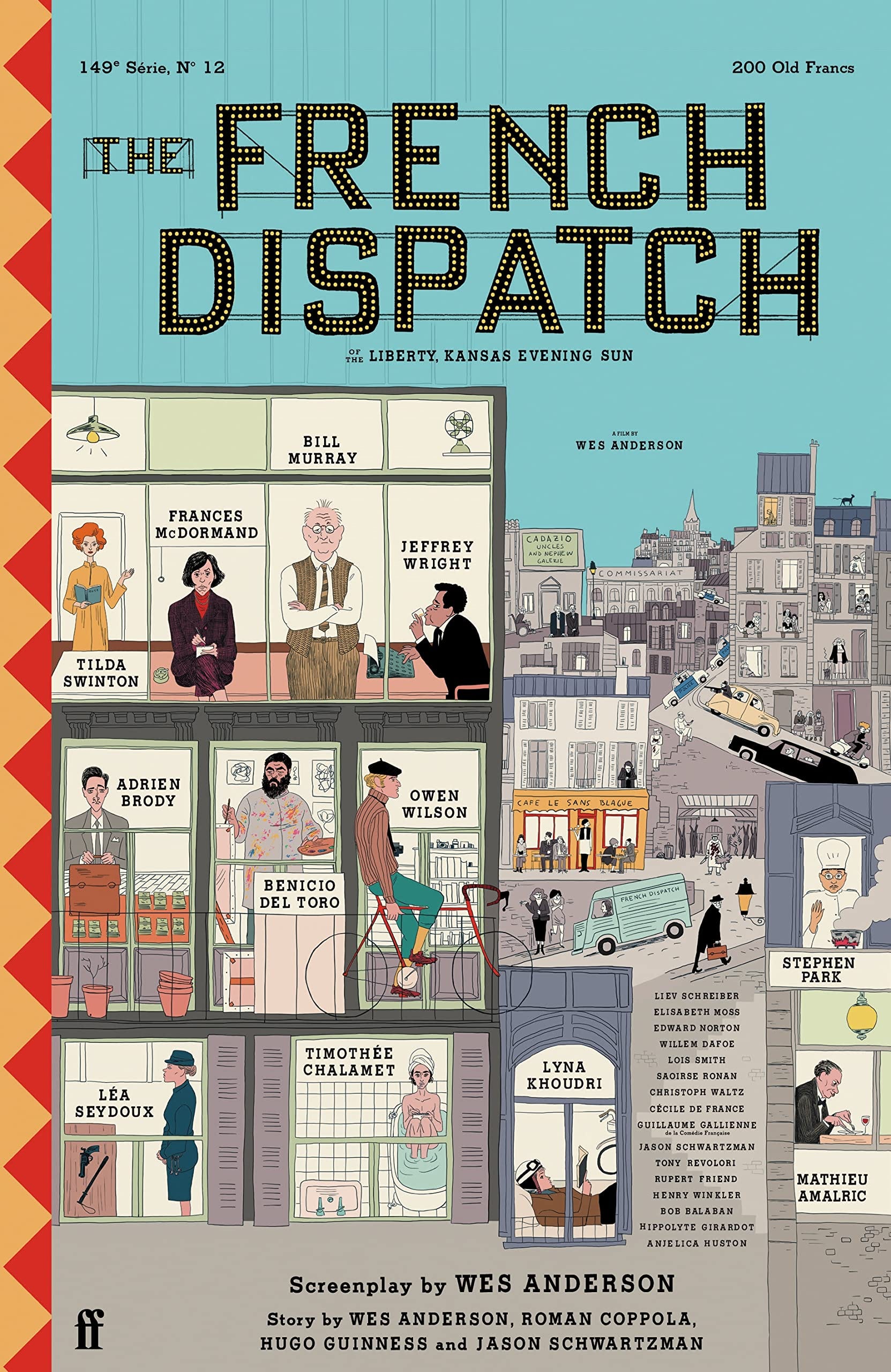
It started with a rabbit hole. I was mindlessly scrolling through my phone when I came across a post where astonishingly attractive people were wearing their “uniforms” to be in a Wes Anderson movie. The eclectic mix of pastel, vintage and timeless aesthetics intrigued me. It seems like something out of a futuristic 70s magazine. I couldn’t help but wonder, how had I never watched a Wes Anderson movie?
I googled which movie to start with and as is characteristic of every recommendation article, none of them could agree on a good jump-off. Everyone and their stepmother’s opinion varied. Start with his best film. No, start with his oldest film. Perhaps his newest film? Might as well.
The trailer for The French Dispatch (2021) leaves you caught in a whirlwind of awe. Bragging a cast of Frances McDormand, Jeffrey Wright, Tilda Swinton, Elisabeth Moss, Timothee Chalamet, Benicio del Toro, and featuring Anderson staples like Adrien Brody, Owen Wilson, Lea Seydoux, Edward Norton, Saoirse Ronan, Tony Revolori it seemed a project too… ambitious? Overcrowded? You know what they say, too many chiefs not enough people. But this wasn’t an oversaturation of directors. I thought maybe the recognizability of all the actors would distract me from the movie. Boy, was I fucking wrong.
The French Dispatch (of the Liberty Kansas Evening Sun) is a picnic magazine sold to readers of the Kansas Evening Sun. Editor Arthur Howitzer Jr. (Bill Murray) started the magazine when he moved to Ennui-Sur-Blasé, France. It’s unclear what the readers of Kansas would want to know about Ennui, France but that wasn’t Howitzer Jr’s problem. His was but to write and print. He had a team of carefully collated authors, some of the most eccentric, best and brightest in the global north to cover “weekly reports of world politics, high and low art, fashion, fancy cuisine, fine dining and human interest”. The goal of the French Dispatch was to “bring the world to Kansas”. Well, it brought Ennui to Kansas, but ok.
1. The Cycling Reporter
The movie is an anthology. Similar to the magazines it’s paying homage to. First up was Herbsaint Sazerac: The Cycling Reporter. Played by Owen Wilson, Sazerac’s too brief appearance on screen denied me the chance to enjoy Wilson’s formless charm. His story starts simply, “Ennui rises suddenly on a Monday”. He proceeds to dissect the city, showing absurdities of Ennui such as how “8.25 bodies are pulled from the Blasé River. A figure which remains constant regardless of population growth.” That startled a laugh out of me. Sazerac’s people were “rats, vermin, gigolos and streetwalkers”. As the coverage of a day in the life cycle of Ennui runs its course.
Sazerac was based on The New Yorker’s Joseph Mitchell who died in 1996 at the age of 87. The Columbia Journalism Review described Mitchell as “the late New Yorker reporter who wrote portraits of oystermen, bearded ladies, saloon keepers, gypsies, and other assorted characters sometimes described as New York City’s little people.” It further goes on to describe Mitchell as a specialist of post-Depression New York.
Interlude
Now at this point, I have to get a bit personal. Interludes are always welcome, no? Especially, to allow an author a moment of rumination.
For the longest time, I have loved reading. Growing up, I was the biggest book nerd I knew. But while I was exposed to classics at a young age, they were too advanced for me. I was too green to appreciate the world before me, much to the chagrin of my father, who believed exposing me to Alfu Lela Ulela at 10 years old would help me become some stoic leader of thought. It was the furthest thing I was. His disappointment was palpable when the next book I asked for was a popular children’s horror series.
After college, I was a mess. A rudderless millennial overtaken by woes of broken dreams and broker accounts. But few things gave me as much joy as books and magazines. By the late 2010s, I was devouring free articles (still broke by the way) and using whatever avenue I could to read all the literary journalism that I could get my hands on. I was religiously subscribed to curation sources such as longform.org (they no longer provide this service). I live for the true-crime Vanity Fair reports and the sweeping world coverage stories of The New Yorker. I camp on Harper’s Bazaar’s Twitter account waiting for the next best feature profile of a postmodern seminal fashion trendsetter or editor. I wait for The Paris Review to share their blue moonly free article. All of them fell prey to my hungry eyes but none more so than The New Yorker.
I paid for subscriptions when I could afford them. Present history by poetry. It was hard to describe the elation I would experience every time I read Masha Gessen’s latest anti-Putin treatise. Or Jia Tolentino’s reflections on Instagram face. Richard Brody’s movie reviews. Doreen St. Felix’s thoughts on American Blackness. Evan Osnos’ dispatches from China. It felt like an addiction that could only ever be cured by a trip to the One World Trade Centre. Only a fool would dream of that. I simply follow the authors on social media.
The magazine is as part of my personality as my compulsion to smell books. When I realized this film was an homage, paeans to the art of the story—it felt like it was made for me. I cried by the time the story moved from Sazerac’s story to Berensen’s. And it’s time I should too.
2. The Concrete Masterpiece
Lea Seydoux’s Simone stands naked. The stark grayscale accentuating her beauty. Benicio del Toro’s Moses Rosenthaler studies her with an artist’s gaze. Perhaps predatory, perhaps ardent ultimately male. Altogether, he’s still the painter and Simone his nude muse. He rearranges her arm, puts his paintbrush against her belly. She shoves it away and resumes the pose. A bell rings. Exit stage right. Simone emerges dressed in a staff uniform and Rosenthaler in overalls and a strait jacket. The male gaze back where it belongs.
Switch to colour, Tilda Swinton’s resplendently orange Berensen begins her presentation. Based on art historian Rosamond Bernier, Berensen is offputtingly charming. She strikes one as a woman who hides ego behind unconventionality. Enjoyable only in micro doses. Such as her lecture.
Bernier was a remarkable character. Vogue labels her as an animal tamer, pilot, friend of Frida Kahlo. She was Features Editor for Vogue in post-war Paris.
Berensen starts her narration by narrating the brief histories of the main players of this story. Adrien Brody’s Julien Cadazio was based on British art dealer and gallery patron Joseph Duveen and of course Rosenthaler.
Most striking to me was a subtle criticism on modern art. When Cadazio eagerly shows his uncles what he discovered where Rosenthaler is serving his time, I could accurately describe it as Splotch by Painter. However, Cadazio explains to his uncles that a good modern artist can draw a thing that looks like what it’s supposed to look like then their abstract splotch can be worth exorbitant amounts of money when the desire is created. Using Rosenthaler’s prison sentence, Cadazio creates a scarcity of Rosenthaler’s art by ensuring his parole is revoked for the entirety of his sentence.
Present as well, socio-political musings on talent as a shield from consequence, a reminder of how talented men are often spared the furthest ramifications of their crimes. Cadazio pontificates at Rosenthaler’s parole hearing, “However, he’s also that rare once-in-a-generation guy that you hear about, but never get the chance to discover for yourself. An artistic genius.”
There were such calls for clemency for men who were revealed to be abusers and rapists. As though their talent was so valuable to the world, that to be denied their art is a far bigger crime than these sins of men. As The Atlantic’s Megan Garber puts it: “Genius cannot be reasoned with. Genius is the answer and the question. It will be heard. It will be respected. Even when it kicks and stalks and climbs up the side of the house at night… Genius, a male condition that inflects its maleness on the individual soul. Genius, an object of worship.” The consequence of genius is ours to bear, not the artist’s, his crimes notwithstanding.
Following this, Cadazio and Rosenthaler get in an uneasy arrangement where Rosenthaler’s art builds Cadazio’s career until a Madam Clampette orders a series of portraits that the eccentric genius turns into a fresco.
It’s easy to then lose the willingness to pursue this story by this point because it begins to feel self-fellating.
3. Revisions to a Manifesto
Frances McDormand’s Lucinda Krementz is cut-throat, succinct, cogent. Her style of narrating is staccato, a beat. Based on the late Mavis Gallant, Krementz is on assignment to cover a campaign in an unnamed school at Ennui. The campaign of the slogan, “les enfants sont grognons’—the children are grumpy.
Gallant was a Canadian essayist and short story writer who lived in Paris. The New York Times describes her writing as “a deep-rooted sense of place, inviting the reader into a Paris walk-up or a sheet-shrouded marble hall in Montreal.”
Krementz doesn’t have the same sense of welcome. She’s abrupt, brief, almost strict. One of my favourite characters in the whole film. In the second act of this third act, Krementz is set up by her friends to meet a man. Her perceived loneliness bothers them. Some people aren’t happy until you’re unhappy by their standards. If you’re a woman, the only problems you should have are a man or a child. Krementz’s speech protesting the ambush encapsulates a lot of what many of us child-free women wish we could say, “Take me at my word. I live by myself on purpose. I prefer relationships that end. I deliberately choose to have neither husband nor children. The two greatest deterrents to any woman’s attempt to live by and for writing.” If ever there was a monologue, however brief, that deserved a standing ovation…
Krementz’s style eschews pronouns and articles. It’s not the wheels on the bus go round and round. It’s a bus, wheels turning. Is artistic or stylistic? Does it matter if it’s fantastic?
Gen Z heartthrob Timothee Chalamet joins. He’s the son of Krementz’s overbearing friends. Enter Krementz, bathroom. Chalamet’s Zeffirelli, a caricature of egotistical pseudo-revolution, lounges in the bathtub. He’s bashful, self-aware, “I’m shy about my new muscles”. He’s working on something. Krementz curiously asks what it is. It’s a manifesto for the grumpy children. He darts out and hands her the tiny notebook. For a well-known thirst trap, no nudity is shown. Does the female gaze matter so little?
Zeffirelli gives Anderson a chance to poke fun at the petulant writer. Every writer, really. After Krementz peruses the manifesto, she has notes. Zeffirelli is gobsmacked. He’d expected praise, “I only asked you to proof read it because I thought you’d be even more impressed by how good it already is.”
It reminded me of when I hunted down my primary school English teacher to share with her a now-defunct blog and get her opinion. I hoped for heaps of acclaim, comparisons to Paul Theroux, actionable advice to make it better. Anything sound. “It’s nice,” her reply said. The most disheartening compliment. I never asked for feedback from a teacher again.
Zeffirelli and his peers are a portrayal of prehistoric millennial angst. Walking talking Twitter accounts. He explains, “Devil’s advocates bickered and debated perpetually, ad nauseum, only for the sake of argument.”
When a debate ensues among the students about the role of men in war, more commentary shyly pokes it head. Like a rabbit checking for hazards before darting off to adventure. Are these men perpetuating totalitarianism or do they have no choice? Can we take a look at the role of French colonization and military occupancy in North Africa? What role does Art by Capitalism play in the service of imperialism? No sooner have you started to reach for an argument than the commentary is railroaded. Back to your hole little rabbit.
A play within this play of a film starts, Goodbye Zeffirelli. A snapshot. A monologue on the misery and agony of existence. Military service offers these young men a brief respite from existential dread over designing their purpose, from adulthood. Until one soldier is asked what he wants to be once his mandatory service is done. Screen darkens. Camera pans. Zoom on boy’s back. Boy, Morisot, faces window. Shot is bleak, sharp, cast in shadow. Darkness looms.
“I won’t do it,” He answers. “…That 48-year period of my life, I mean. That’s what I won’t do. I can no longer envision myself as a grown-up man in our parents’ world.” Window opens. Boy falls. Tragic. Astute. Millennial existentialism in less than three minutes.
The segment continues. A chessboard conflict. Police vs Protestors. Unfortunately, a springboard for an enemies-to-lovers romance. Perhaps wish fulfilment for all the young people madly in love with Chalamet? The piece offers a mild critique of idealists. Split into factions that would serve better under a unified front. A hierarchy of who’s doing the most for The Greater Good™. You’re unwelcome if your manifesto isn’t the fairest of them all. The reflection is consumable, adroit then devolves into petty jealousies and thinly veiled ageism. A stain against otherwise stellar filmography. The police inevitably descend into violence against the juvenile protestors. The film moves on to the most bizarre metaphor for fucking since Breaking Dawn Part Two’s Windows Media Player graphics. It felt wholly unnecessary. In the end, Zeffirelli dies in a manner as bizarre and benign as his arc.
4. The Private Dining Room of the Police Commissioner
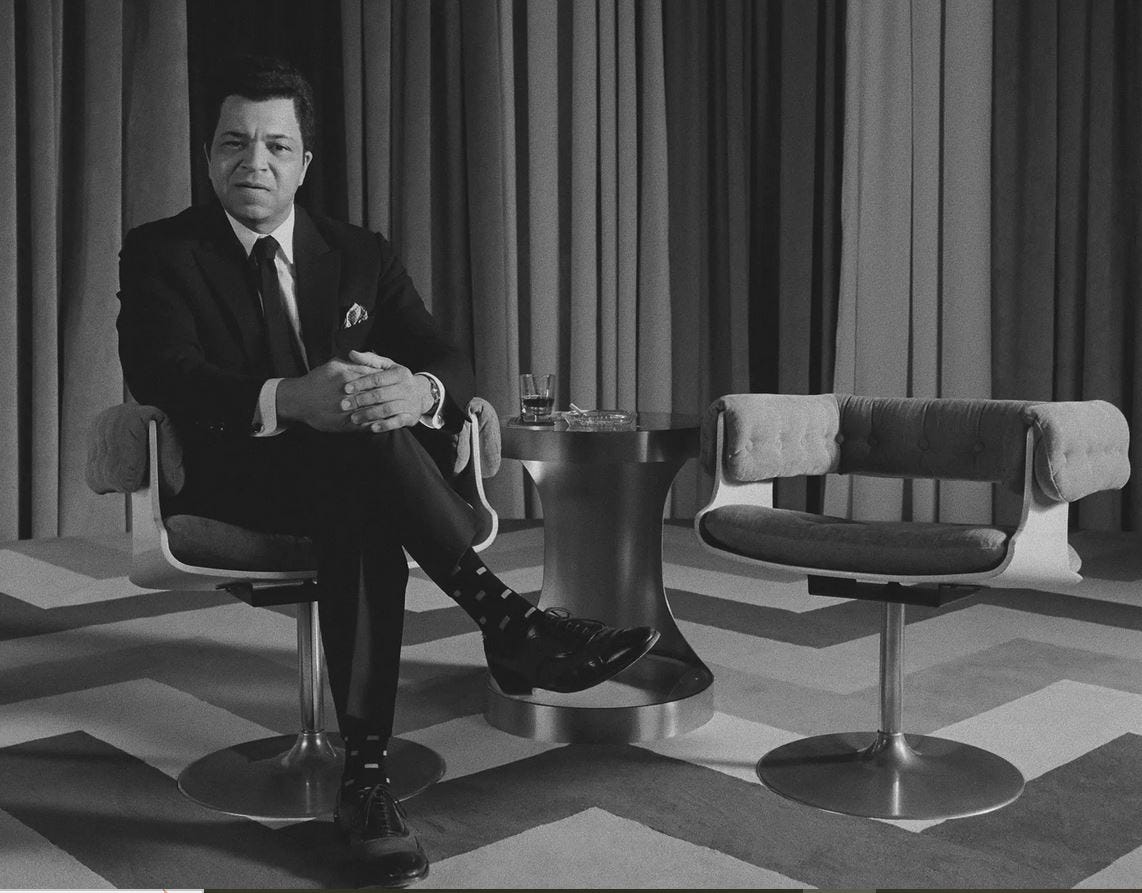
Easily my favourite part of the whole film. Zany, unpredictable, uncanny, brilliant. Perhaps even the proglottid that had the best combination of actors. Jeffrey Wright, Liev Schreiber, Saoirse Ronan, Edward Norton, Mathieu Amalric, Steve Park, Willem Defoe etc.
Jeffrey Wright plays Roebuck Wright (no relation) a food writer for The French Dispatch who is invited on a talk show hosted by Schreiber’s Dick Cavett. In it, Wright (the real one) and Schreiber jump off each other beautifully, in interviews reminiscent of Larry David’s heydays. In actuality, it’s a riff of Baldwin’s interview on The Dick Cavett Show for the opening of the I am Not Your Negro documentary. Wright (the movie one) has a typographic memory. He remembers every word he ever wrote. He relives the titular article for the audience. He’d been invited to dine with the Police Commissioner’s (Amalric) famous weapon, Lieutenant Nescaffier (Park).
Wright is based on James Baldwin and AJ Liebling. Baldwin was a prolific author, one of the most important and iconic Black authors of all time. Liebling was food contributor at The New Yorker.
When Wright arrives at the commissary and confesses to a weakness in cartography. He calls it the curse of the homosexual. Is it any surprise he can’t walk straight? (I’ll see myself out). He’s a guest of the commissary to get his first experience at police cooking.
Turned around in his excursion, finds himself facing the “chicken coop”, where he was once a guest. A sad lonely small wiremesh enclosure more suitable for livestock than a man. He eventually makes it to the kitchen and there he meets the Police Commissioner, his other guests and his beloved son, Gigi (Winset Ait Hellal). As Wright indulges in decadent aperitifs, daddy’s budding commissaire is kidnapped by hot air balloon from his attic study. The sequence is interspersed with animated stills and monochrome shots, old cinema meets cartoon sitcom.
The kidnappers have demands for the commissioner, which most kidnappers are wont to do, but his demands are a bit more—unique. This is something only the commissioner can do for him. Cavett interrupts Wright’s narration which he has to bookmark, where he is asked to explain his backstory.
“Love the wrong way and you’ll find yourself in a great deal of jeopardy,” he concludes. Which is surprising considering France’s self-appointed crown as the world’s liberalism prefects. Wright is sentenced to the chicken coop for six days. His only resolve is to call the phone number of the people he’d come to visit. His reason for being in Ennui was an interview with The French Dispatch. He calls Howitzer Jr., who comes to bail him out even after rejecting his submissions. He is given an assignment to read a book and write a 300-word review. Wright is overcome and looks to his gifts and promise of freedom, employment. He wants to cry.
“No crying,” Howitzer Jr. reminds him.
We are zipped back to the rescue attempt by the commissioner. But first, they feast. Nescaffier serves deviled eggs of precinct canary served in meringue, kidneys poached in plums, mixed lamb bon-bons in pastry wrappers, oyster soup, pigeon hash and finally tubac pudding with quadruple cream.
Cavett can’t help but interrupt again, much to Wright’s exasperation. He asks him why. Why the profligate obsession with food?
“Who, what, when, where, how. Valid questions. I learned as a cub stringer, never, under any circumstances, if it’s remotely within your power to resist the impulse, never ask a man why… Self-reflection is a vice best conducted in private or not at all.” It was almost refreshing to see a genius who wasn’t interested in navel gazing.
The lights went out, the pastels dimmed. Wright explains with such discreet poetry the companionship of a meal waiting for you after a long lonely day in a new home that ostracizes you, “It is the solitary feast that has been very much like a comrade, my great comfort and fortification.”
Before you can shed a tear for such a beautiful ode to the solo date, we’re yanked back to the main story. Gigi asks for a meal. A gambit to get the police access to the hideout. At first the kidnappers want nothing to do with it until they learn that Nescaffier is available. Only a fool turns down a chance to taste Nescaffier’s cop cuisine.
This soon leads to an animated car chase rescue sequence and a conclusion to warm the cockles of your heart as thoroughly as pudding. This section was hilarious, charming and cathartic. Beautiful.
5. The Death of Arthur Howitzer Jr
Howitzer Jr. is based on the editor and founder of The New Yorker, Harold Ross. He started the magazine in 1925 with the help of a wealthy friend. Like, Ross, Howitzer Jr dies of a heart attack.
In the ensuing sadness, the orchestra for this meticulous magazine symphony gather in his office to sing one last hurrah—his obit.
The film is dedicated to the founders, editors and contributors of The New Yorker. It ends and echoes with the resounding motto of the visionary editor, “Make it sound like you wrote it that way on purpose.”
Some consider this to be Anderson’s weakest film. I wouldn’t know. I’ve only watched three as of the scribing of this piece. It’s borderline inaccessible. Niche. One may even go as far as calling it pretentious, my siren call. Some reviewers say it’s a film for Anderson diehards. I believe it’s a film for the fan of The Magazine.
The aesthetic of the film is one that does keep you glued to your seat. Forgiving the film for any long-windedness. It’s sprawling scenes and extended still shots evoke an appreciation for the beauty of film. It’s not utilitarian, rote. You’re not here for boy meets girl, boom pow commercial cinema. There’s a lot being said between the lingering scenes. Or perhaps I am a moth helplessly strung by this flaming tableau vivant tale.
To get both looks and use is a quality that seems preordained for luxury. However, avant-garde art that defies austere motifs gives us a glimpse where the best of the past works with the present. Anderson’s films feel timeless. And with the tight symmetrical shots, contemplative peripherals, and all-embracing themes, a viewer can make it anything they need it to be.
Ultimately, it is forgivable to think this should have been a mini series rather than a bunch of vignettes within a sub two-hour film. But I don’t care. It’s my favourite of Anderson’s films so far as I believe, wholeheartedly, albeit fancifully, that it was a film written for me.
More please
A well organized commentary. Enjoyed reading the article.